
- Zoho Development
Why businesses are replacing multiple software platforms with Zoho One in 2026
- AssistFlex Team
In today’s digital landscape, businesses rely on a growing number of software applications to manage sales, marketing, customer service, finance, human resources, project management, and operations. While each tool may solve a specific problem, managing multiple disconnected systems often creates new challenges.
Data becomes fragmented. Teams work in silos. Reporting becomes complicated. Costs increase as organizations continue subscribing to additional software platforms. As a result, businesses worldwide are looking for ways to simplify their technology stack while improving productivity and collaboration.
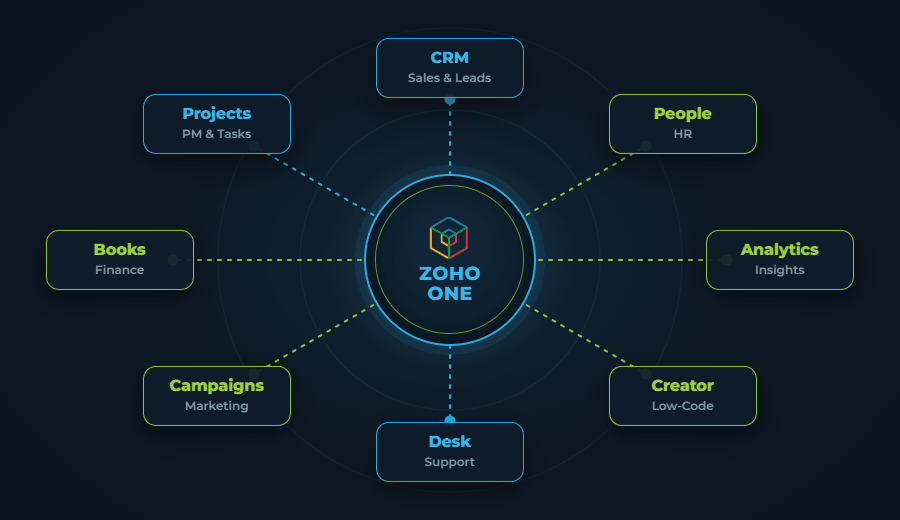
This is where Zoho One has emerged as a game-changer. Often referred to as a complete business operating system, Zoho One brings together more than 45 integrated applications into a single ecosystem, helping businesses manage every aspect of their operations from one platform.
The problem with software fragmentation
Over the years, many organizations have adopted software on an as-needed basis. For example:
- Salesforce for CRM
- QuickBooks for accounting
- Trello for project management
- Mailchimp for email marketing
- Slack for communication
- Zendesk for customer support
While each platform may be effective individually, managing them together often creates significant operational inefficiencies.
Duplicate data entry
Employees frequently enter the same information into multiple systems.
Lack of visibility
Management struggles to gain a complete view of business performance.
Integration complexity
Connecting multiple software platforms often requires additional tools and technical support.
Higher costs
Monthly subscription fees can quickly add up as businesses grow.
Reduced productivity
Employees waste valuable time switching between applications. As organizations scale, these challenges become even more difficult to manage.
What is Zoho One?
Zoho One is an all-in-one business software suite designed to help organizations manage operations through a unified platform. Rather than purchasing multiple standalone applications, businesses gain access to a comprehensive ecosystem that includes:
- Customer Relationship Management (CRM)
- Accounting and finance
- Human resources
- Marketing automation
- Project management
- Customer support
- Analytics and reporting
- Collaboration tools
- Inventory management
- Workflow automation
The result is a connected business environment where information flows seamlessly across departments.
Why businesses are choosing Zoho One
1. A single source of truth
One of the biggest advantages of Zoho One is centralized data management. When all departments use connected applications, information is automatically synchronized across the organization. For example, a sales representative updates a customer record in Zoho CRM, and that information can immediately become available to finance teams, customer support teams, project managers, and marketing departments. Everyone works from the same data, reducing errors and improving collaboration.
2. Lower software costs
Many organizations are surprised by how much they spend on separate software subscriptions. When you combine CRM, accounting, support, project management, and marketing tools from different vendors, costs can become significant. Zoho One consolidates these capabilities into a single platform, often reducing overall software expenses while providing more functionality.
3. Improved team collaboration
Disconnected systems often create communication barriers. With Zoho One, teams can collaborate more effectively because everyone operates within the same ecosystem — sales handing over customers to support, marketing sharing campaign performance with leadership, finance accessing customer billing information, and project teams monitoring customer interactions. This level of visibility improves operational efficiency across departments.
Key applications included in Zoho One
Zoho CRM
Manage leads, customers, sales pipelines, and customer interactions.
Zoho Books
Handle accounting, invoicing, expenses, and financial reporting.
Zoho Desk
Deliver exceptional customer support through ticket management and service automation.
Zoho Projects
Manage projects, timelines, resources, and team collaboration.
Zoho Analytics
Create advanced reports, dashboards, and business intelligence solutions.
Zoho People
Manage employee records, leave requests, attendance tracking, and HR processes.
Zoho Flow
Connect systems and automate workflows across applications. Together, these tools provide a comprehensive foundation for modern business operations.
The rise of unified business platforms
Businesses are increasingly moving away from fragmented technology environments. Instead, they are embracing unified platforms that support:
- Better collaboration
- Faster decision-making
- Greater efficiency
- Improved customer experiences
The trend toward digital transformation has accelerated this shift. Organizations no longer want software that simply performs individual tasks — they want systems that work together seamlessly. Zoho One delivers exactly that.
Real-world use cases
Growing professional services firms
Consulting firms often need CRM, project management, invoicing, and client portals. Zoho One allows these functions to operate within a single environment.
Healthcare and medical organizations
Healthcare providers can manage customer relationships, scheduling, documentation, reporting, and internal operations through an integrated platform.
Recruitment and staffing agencies
Recruitment businesses can streamline candidate management, client relationships, workflow automation, and reporting while improving operational visibility.
E-commerce businesses
Online retailers benefit from inventory management, customer support, marketing automation, and analytics — all connected within a single ecosystem.
How AI is enhancing Zoho One
Artificial intelligence is becoming increasingly integrated across the Zoho ecosystem. Businesses can now leverage AI for:
- Lead scoring
- Sales forecasting
- Workflow recommendations
- Customer insights
- Content generation
- Business intelligence
As AI capabilities continue to evolve, organizations using Zoho One are positioned to benefit from innovations across the entire platform.
Is Zoho One right for every business?
While Zoho One offers significant advantages, every organization should evaluate its unique requirements. Zoho One is often an excellent fit for businesses that:
- Use multiple software applications
- Want to reduce operational complexity
- Need better reporting and visibility
- Plan to scale operations
- Seek greater automation opportunities
Organizations looking to consolidate systems often find Zoho One provides substantial long-term value.
Implementation considerations
Successful implementation involves more than simply activating software. Businesses should consider:
Process mapping
Understand how departments currently operate.
Data migration
Ensure historical information is transferred accurately.
User adoption
Provide training and support to maximize engagement.
Automation opportunities
Identify repetitive tasks that can be streamlined.
Reporting requirements
Establish dashboards and KPIs that support decision-making. A structured implementation approach helps organizations maximize return on investment.
How AssistFlex helps businesses implement Zoho One
Frequently asked questions
What is Zoho One?
Is Zoho One suitable for small businesses?
Can Zoho One replace multiple software platforms?
Does Zoho One support automation?
Final thoughts
The future of business technology is integration, automation, and simplicity. Organizations that continue managing multiple disconnected systems may find themselves facing higher costs, operational inefficiencies, and limited visibility into performance.
Zoho One offers a compelling alternative by bringing business operations together in a single, connected ecosystem. Whether you’re looking to improve collaboration, reduce software costs, streamline processes, or prepare for future growth, Zoho One provides the tools needed to support modern business success.
- OPTIMIZE • AUTOMATE • SCALE
Let's get more from your Zoho
Book a free 30-minute consultation and we’ll map your quickest wins — no pressure, no jargon.
- Free, no-obligation call
- Zoho specialists, not generalists
- Reply within one business day